
I Was an Early Believer in Government Social Media. I Still Am, Just Not About the Comments
What changed, and what didn't

Last week I told the story of two cities that turned off their comments. This week, why I changed my mind about what that decision means and what you should do if you make that (defensible) call.
In 2006, Brooks Bennett and I sat in a conference session and watched a clip of the head of the Associated Press admit the AP didn’t own the news anymore. The session was about a new thing nobody had quite named yet. Some called it new media. Facebook was still walled off to college students, and Twitter was brand new. I was a journalist before I was a communicator, so the line carried weight. If the AP didn’t own the news, then nobody did. News had just gotten more democratic, and a city could now reach its residents without the media deciding what got through.
We tracked down one of the session presenters, Linda Zimmer, and she helped us write a policy for this strange new thing. The policy even noted, as I remember it, that these platforms weren’t formal public hearings. We set up a city blog and Facebook and Twitter accounts, then sat on them, not quite ready to flip the switch.
We were in Brooks’ office finishing the setup when City Manager Jim Nuse stuck his head in to ask what we were working on. A new way to talk to residents, we told him. Good work, keep at it, was the gist of his response, and he was gone. That was the whole approval process.
We launched with a public note saying we’d give it a six-month trial. If the comments spiraled out of control, we’d pull the plug. Six months came and went. I’m not sure we ever made a formal decision to keep going. The thing was working the way we’d hoped, so we kept moving.
Hold onto that last detail, because it’s the one I lost track of for almost 20 years. The off switch was in the plan from the first day. Turning off the comments wasn’t a failure we were guarding against. It was the contingency Brooks and I wrote in on purpose, the safety valve we promised residents we’d use if the thing turned ugly.
And then, nearly two decades later, I watched other cities reach for that exact valve and decided they were cowards.
I was wrong.
Why I called it a cop-out
I had two reasons, and I believed both.
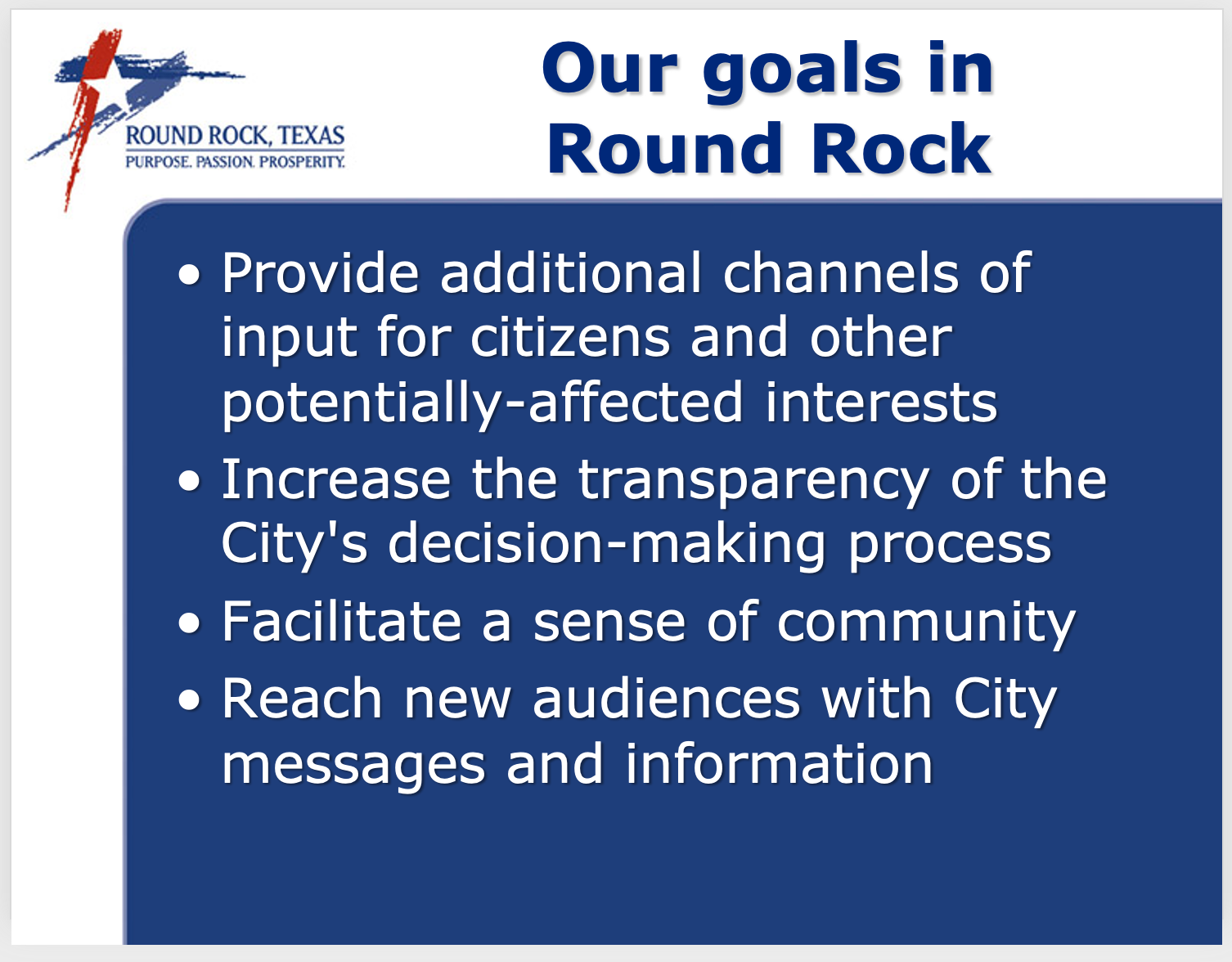
The first was conviction. I dug up a slide from a presentation in those early days, and there in black and white was the first goal we set: additional channels of input for citizens. I believed in the democratized news so completely that pulling back from it felt like surrender, like a city giving up on its own residents.
The second was competence. Most of what I know about engaging the public I learned from Bleiker Training, and at Round Rock we put it to work on every contentious project we touched, and there were a lot of them: regional water, animal control code changes, a minor league ballpark, transportation plans. We got them all approved. We knew how to handle hard questions and a hostile room. So when a city said it couldn’t manage its comments, part of me heard an excuse. We managed ours. Why couldn’t they manage theirs?
By 2010 I was on a stage at SXSW Interactive with a talk called “How Nerds Can Foster Democracy in Local Government.” I believed every word of it.
I was right about both of those, in the moment. That’s what makes the rest of the story worth telling.
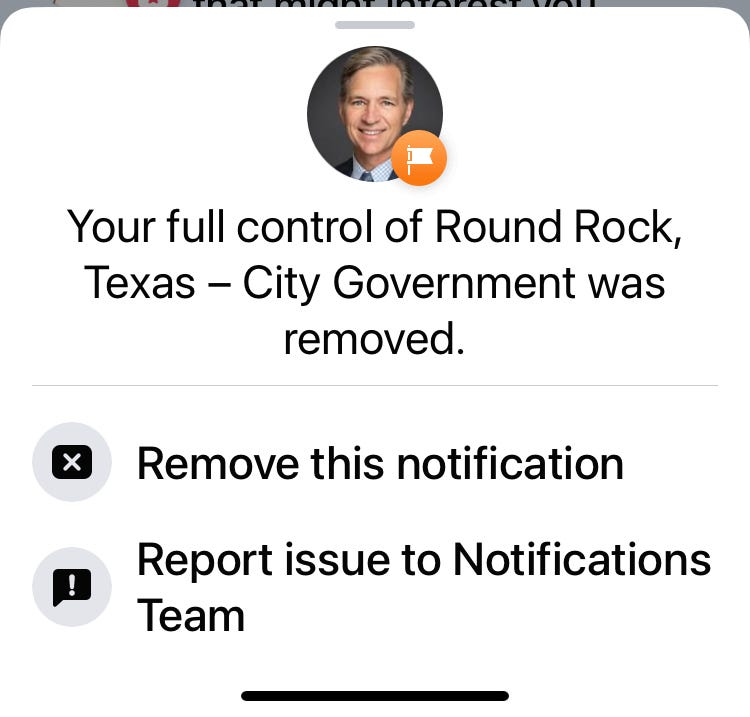
The day I retired, I was removed as an administrator of the city Facebook account, the one Brooks and I had switched on with such optimism all those years before. I’d handed the daily work to Austin Ellington five years earlier, so nothing in my daily routine changed. What changed was how I felt. It was pure relief. I kept a screen grab of the notice, because handing off that responsibility for good felt like setting down a weight.
What changed
What broke the dream was the machine that got built around the people using it.
The platforms make their money selling ads, and they earn it by holding your attention, and the surest way to hold attention turns out to be conflict. Somewhere along the way the tool stopped being a way to hand residents the news and discuss it, and became a way to start a fight and keep it burning.
Peter Thiel once griped that we were promised flying cars and got 140 characters instead, that a generation of brilliant engineers went to work making us click instead of helping us fly. That’s a truth I waved off while I was quietly judging the cities that turned off comments. The algorithms are tuned to deliver one dopamine hit after another, and we keep chasing the next one, the way an alcoholic chases the next drink.
I am not above any of it. I have been sober 37 years. I understand the machinery of addiction better than most. And I still went down a YouTube rabbit hole last night.
If the algorithms can beat someone with that much practice at noticing the pull, then willpower was never the variable. And the competence I was so proud of, the thing that let me look down on the cities that turned off comments, didn't decide it either. The platforms changed the game, even for people who were good at it.
The argument for leaving comments on
The sharpest pushback I got came from someone who has no intention of quitting. Jeff Newpher manages communications for the city of Granbury, Texas, and he keeps comments on as a matter of principle. “My responsibility is to communicate with all residents,” he wrote after reading last week’s post, “not just the small number who post negative comments.” He won’t let the angriest accounts set the terms for everyone else. “The negative voices are the loudest, but I don’t want them to determine how everyone else can interact with their government.”
When Granbury started posting about the data center regulations its council adopted in April, engagement jumped 228 percent over the prior two months. The comments ran about 95 percent negative, and Jeff’s point is that the channel was still doing its job for the reasonable majority reading along in silence. Then he asked the question I couldn’t wave off. “If communication becomes increasingly one-way, where do the many reasonable residents on that platform go to ask questions, raise concerns, or seek clarification?”
Why there is no single right answer
So who is right, Jeff or the cities that switched off? Both. I told Jeff as much when I wrote him back. This is a call every city has to make on its own terms, shaped by its experience, its politics, the health of the relationship between its council and its staff, and the stubbornness of its own bad actors. He agrees there’s no one right answer.
Kevin Keller in Copperas Cove told me last week about one man who slammed the city on Every. Single. Post. Turns out, the guy doesn’t even live there. Copperas Cove is hardly alone. Scroll the TAMIO or 3CMA Facebook groups and you’ll find PIOs asking how to handle the same thing, the relentless troll treating the city’s page as a personal play pen. You can’t write one rule for all of that.
Where people go
That leaves Jeff’s question, and it has an answer. The problem was never online input. It’s that the algorithm elevates the nastiest takes, and in doing so it manufactures the very thing that makes governing hardest.
To govern well, you need civil discourse. That doesn’t mean everyone agrees. It means people can disagree and still see each other as neighbors rather than enemies. The algorithm is tuned against exactly that. It has learned that “you’re wrong” travels slower than “you’re evil,” so it feeds us the second one, and our politics now sound like the feed. Every hour you spend refereeing that is an hour stolen from the work that actually builds civil discourse. That’s the real cost of leaving the comments on. Not the abuse. The opportunity.
So turn them off if you need to, but don’t stop there. Do two things in their place.
First, give residents another way to weigh in online. An engagement platform on your own website lets people ask a question, react to a proposal, and leave real feedback, with no algorithm rewarding a pile-on. You give up some of the reach that comes from being where people already scroll. What you get back is a conversation that isn't engineered against you.
Second, go to where people already are IRL. I spent this spring writing about cities that stopped waiting for residents to show up and met them in person instead. Here are two:


That’s where the trust gets built, and it’s where the civil discourse you can’t get in a comment thread still happens.
I was the guy telling everyone to get in the water. I still believe in the work. I've just stopped believing you need the comment section to do the work well.
There’s one more reason I came around. It has nothing to do with reach or law or strategy. It’s about what the comment section does to the people who run it, day after day, until they stop noticing the weight they’re carrying. That’s where this series wraps up, next week.
Onward and Upward.