

One of the loudest critics League City ever had on Facebook used to also call the city manager to complain. Now he turns up in the same comment section to defend the city, sometimes posting a link to the right information before staff can get to it, sometimes praising a department head by name.
He didn’t chill out with age. League City invited him in, to have real conversations with the leaders whose decisions he questioned ad nauseam.
This is the second story in a series on countering the negativity that comes standard with local government social media. Georgetown works the problem from the top, telling an engaging story residents see before they reach the comments. League City works it up close, by inviting its fiercest critics out of the feed and into a room.
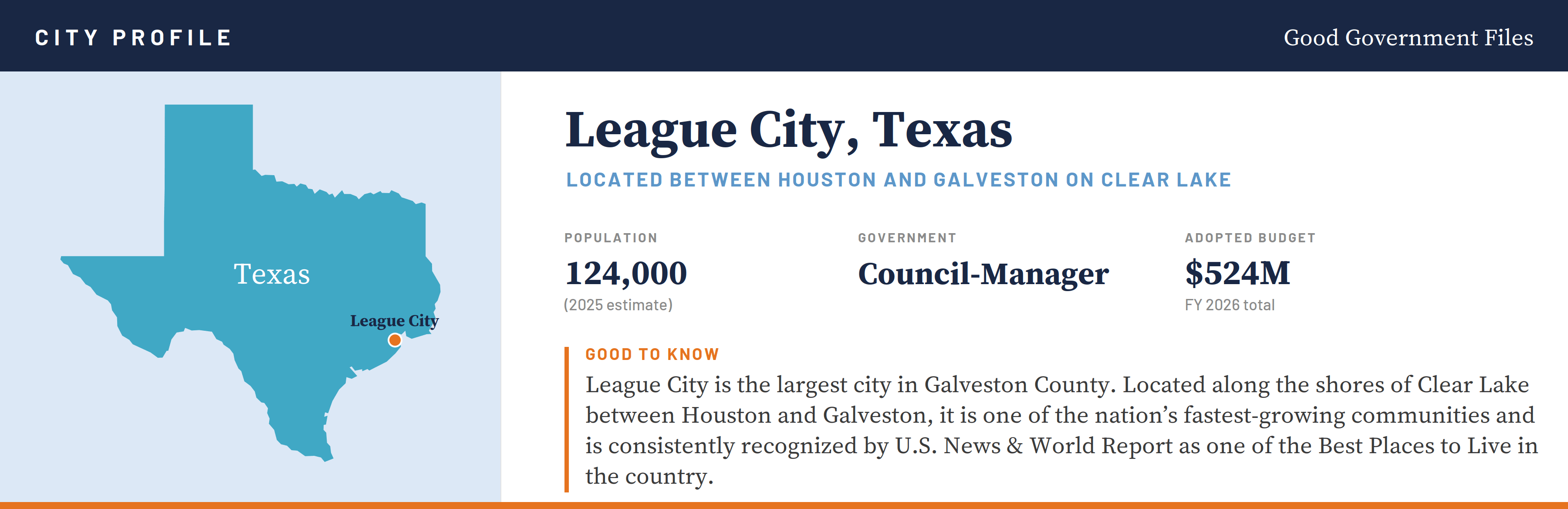
Ashley Donde has run League City’s social accounts for seven years. We met over breakfast at a conference this summer when talking comments on/comments off, and her story stuck with me. One of the first things she told me is she never tried to answer every comment. The city had its regulars, a few recurring trolls who seemed to find joy in criticizing everything. Most of the nasty comments she left alone.
Ashley’s thinking is a complaint about something as complex as, say, a drainage project (100-year floodplains, impervious cover, retention ponds vs detention ponds, etc.), can’t be easily explained in a reply box.
The turning point for Ashley was a billboard campaign. League City put up billboards promoting the city to visitors, paid for with hotel occupancy tax dollars, which by law can go only to a short list of tourism-related uses, not to roads or sidewalks. Staff was excited about it, because it was the first time to use the medium of roadway signage. The public? Not so much. The comments came fast and furious. Why spend on billboards when my street floods, when my sidewalk is cracked? She thought the correction was simple, so she made it. It made things worse.
“Logic does not move the needle,” she told me. “It just doesn’t.” Someone commenting from an emotionally-charged place will not be talked down by a reasonable answer. She was right about the funding restrictions, but being right didn’t squelch the vitriol online.
So League City moved the argument. If a critic won’t be reached in the feed, reach him somewhere else.
Come on in
The idea came from the city manager. One of the worst offenders, the one who called and emailed without pause, got a suggestion: you’d get more out of Citizen University, where you can put your questions to the staff who actually do the work, than throwing rocks on Facebook.
Citizen University is League City’s residents academy. Eleven weeks, one evening at a time, a different department each session, background checks required because the tours include public safety facilities. Plenty of cities run something like it, and that is what makes this replicable. If you already have a citizen academy, you have the IRL platform. You only have to buck up and choose to fill a few of those seats with the people giving you the hardest time online.
People arrive ready to interrogate, Ashley says, but the posture doesn’t survive the introduction. “We’re not the big bad government out to get you,” is the message that gets through. “We’re just your neighbors.” In League City, next door to NASA’s Johnson Space Center, your neighbors include rocket scientists and the astronauts shot into space by their handiwork.
That backdrop gives her a yardstick for humility. She is not going to quiz the man who just flew around the moon on the city’s form of government, and she doesn’t expect residents to know how hotel tax dollars work either. She didn’t, before this job. She took the Citizen University class herself, as a resident, before she ever worked for the city. “We are all just trying to get through life,” she said.
That humility is real insight, and I think it’s critical for communicators to embrace. Ashley treats every resident as someone with a right to the information, the trolls included. “The trolls matter just as much as the NASA engineers or the astronauts,” she said. “They all are paying taxes. They all live here.” The job isn’t to win. It’s to make sure everyone can find what’s true.
She learned the hardest part of that from the police chief, during a controversial case a grieving family wanted to go viral. He told her some people won’t be satisfied no matter what you share. “Your job is not you,” as she puts it. “It’s not you.” You can care about the work without carrying every belligerent comment home.
More than one front
Citizen University is one front, not the whole strategy. League City Listens gives residents a place to ask questions online and get them answered. A community engagement manager sets up tables at parks and the library and sits in on HOA meetings, sometimes with the city manager and a director along. Ashley calls it fire prevention, “clearing the dead trees before the fire erupts.” The best result is that residents start defending the city themselves, which lands harder than the city defending itself, because to a critic the city is always them.
If she spots a trend among the complaints, the comms staff will create a video or write an article for City Matters, League City’s award-winning quarterly magazine mailed to every household in town, about the issue in question. It’s a bank shot, but it avoids a fruitless back and forth in the comments while still getting the correct information out to the community.
Is it working? Ashley has no dashboard for sentiment. “The data is just in my head,” she said, and she’s the one living in the comments every day, so she would know. One critic dropped off entirely. Another, the one who used to call the city manager, now argues on the city’s behalf. The feed reads more respectful than it did.

None of this is about appeasing trolls. It’s about getting good information to everyone who lives there, which is the quiet center of the third element in my framework, citizen participation and listening. League City listens in a dozen ways, and the comment section is only one of them. That’s how high performers do it in this business.
The trolls, Ashley reminds me, are residents too.
Georgetown reshaped the conversation from above. League City moved its critics out of the feed and in front of actual public servants. The series finale stays in the feed and shows how to build community trust the hard way, comment by comment, over years, with all five elements working in alignment. It’s the closest thing to a master class I’ve found in handling negativity, and it’s next.
Onward and Upward.
When your team is trying to win every fight in the comments, the fix usually isn’t a sharper reply. It’s a wider engagement plan, and a comments policy built for your city instead of borrowed from someone else’s. Helping cities build both is the work I do. When you’re ready, let’s talk.