
Where High Performance Governance Begins
How Frisco sets direction during transition—and why it matters for communications and everything else

High performance governance begins with direction.
Before a city can communicate well—really, before it can do anything well—it has to be governed well. That starts with elected leaders coming together, in a work session outside the pressure of regular meetings, to agree on a shared vision for the future and to set clear priorities. When that work is done thoughtfully, it doesn’t just improve outcomes. It makes everything that follows—from execution to communication—more coherent and credible.
Earlier this month, I attended a strategic planning work session in Frisco, Texas, a high-performing city navigating a period of significant transition. What stood out wasn’t a particular project or policy choice, but the discipline of the process itself: elected leaders clarifying roles, reaffirming long-term direction, and giving staff the clarity they need to move forward over the next 12 months with confidence.
For those not familiar, Frisco is one of the fastest growing and most visible cities in the country. Located just north of Dallas, it has become a magnet for corporate headquarters, a rising tech and innovation hub, and a national destination for professional and collegiate sports. With master-planned developments, strong public-private partnerships, and a reputation for disciplined growth, Frisco has paired ambition with infrastructure—without the high costs typically associated with cities of its scale.
Progress in Transition: Governing Through Change
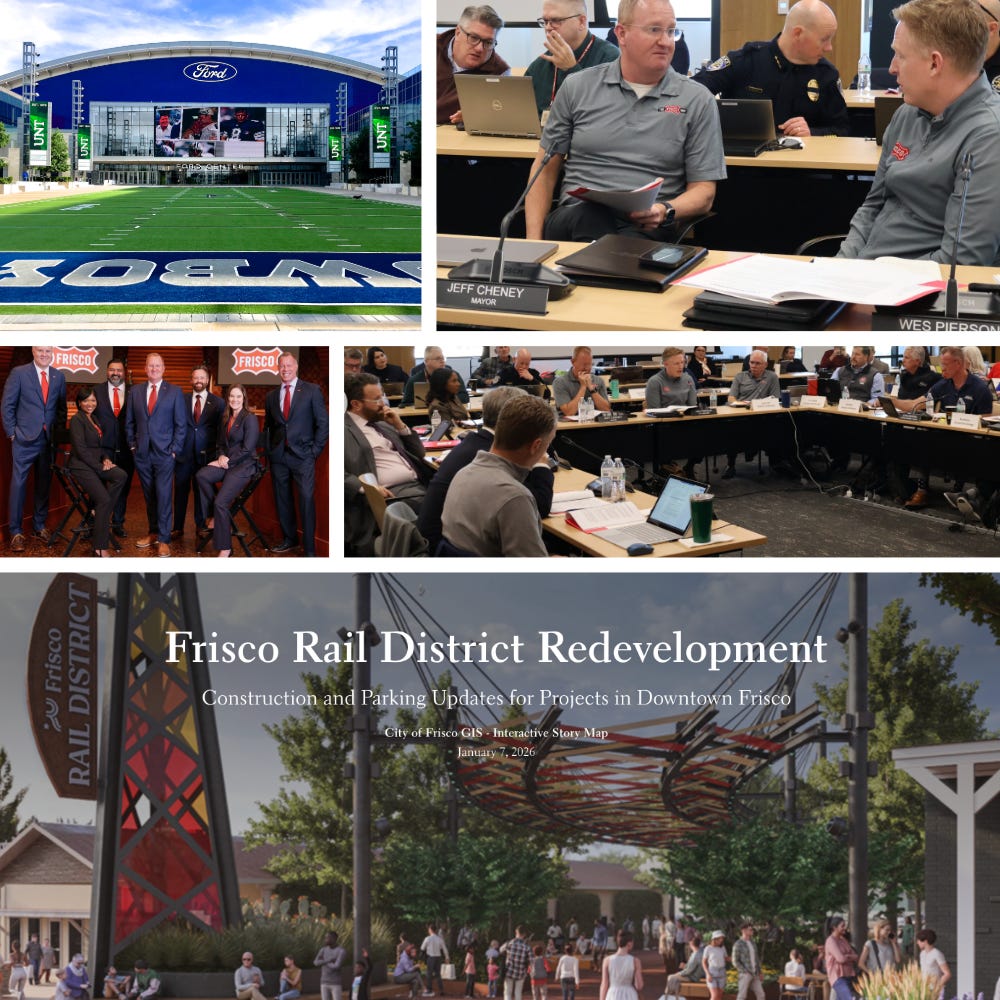
About that transition. The mayor is serving his final term. Several council seats will turn over in the coming months. A long-time assistant city manager is retiring. At the same time, Frisco is preparing for some of the most visible and consequential moments in its history—global events (like World Cup 2026), major developments (like The Mix), and continued growth that will shape the community for decades.
Which is exactly why this work session wasn’t just about setting priorities for the coming year. It was about reaffirming how Frisco governs, how decisions get made, and how elected leaders set direction while empowering staff to carry that vision forward—regardless of who occupies the seats six months from now.
Answering the Why
The day opened with stories—not slides—and that choice was intentional.
Facilitator Mike Mowery of SGR1 began with an anecdote about Southwest Airlines and the power of clearly articulated values. For years, Southwest was explicit about its priorities—employees first, customers second, shareholders third. This wasn’t a slogan; it was a decision-making guidepost for one of the most consistently profitable airlines in history. When leadership later suggested that shareholders had been ignored for too long, people noticed. The clarity that once anchored the organization gave way to ambiguity—and with it, unease. (Not to mention the recent baggage—literal and otherwise.)
Words matter. Priorities matter. And when they shift without a shared understanding of why, organizations drift.
Mike followed with a more personal story drawn from his family’s history in the Texas Panhandle. When farmers plowed fields, they fixed their eyes on a distant point to keep the rows straight. Lose sight of that point, and the work slowly veers off course.
The message landed clearly in a room full of experienced leaders. Periods of change bring opportunity—but without a shared focal point, even successful communities can lose their way.
Before discussing priorities or projects, Mike reminded the council of its responsibility to past leaders who built Frisco’s success—and to residents who are counting on today’s leaders to bring their best. The task wasn’t to solve problems in real time. It was to set direction.
That’s where high performance begins.
Governing Together Means Understanding How Decisions Get Made
Before turning to priorities, the council spent time on something often overlooked in strategic planning: understanding how people in the room process information.
Using results from an I-OPT assessment, council members explored how they take in information, how they move from thought to action, and how those differences show up at the dais. This wasn’t about personality or values. It was about recognizing that some leaders want speed, others want certainty, some want context, and others want options.
None of these approaches is better than the other—but they can clash if leaders don’t understand what’s happening.
Council members shared whether their results resonated and heard feedback from peers. The exercise normalized difference without personalizing it. It also surfaced a critical insight: tensions between councils and staff often stem not from distrust, but from mismatched decision-making styles.
Strategic priorities don’t emerge from individual brilliance. They emerge from collective decision-making—and collective decision-making works best when leaders understand not just what they believe, but how they’re wired to get there.
Emphasizing the Line Between Governance and Management
That understanding set the stage for a reminder on roles.
Ron Holifield, founder of SGR and a former city manager, framed his 12 Rules for Elected Officials as universal principles—not advice for new councilmembers, but guardrails for every governing body, especially during transition.
His message was blunt: great communities are not accidental, and they are far easier to damage than to build.
Several principles stood out:
Governing requires loyalty to the next generation more than the next election.
Mission, vision, and values—not volume or outrage—should guide decisions.
Advocacy is expected. Special interests are part of democracy. But the council’s responsibility is pursuing the greatest good for the whole community.
Data matters more than decibels.
And perhaps most importantly, elected officials must govern, not manage.
Ron used a metaphor that resonated: councilmembers belong on the bow of the ship, ensuring it’s headed in the right direction—not in the engine room, tinkering with the machinery.
Trust, he noted, sets the speed limit. Without it, everything slows down.
Disagreement isn’t the problem. Personalizing disagreement is. Councils are social systems, and how leaders treat one another—and staff—directly affects outcomes. Protecting the integrity of the process matters more than being right.
The Frisco Way: Continuity Without Complacency
With expectations set, the session turned to The Frisco Way—a formally documented approach to governance that has guided Frisco’s well-managed growth for years.
Led by City Manager Wes Pierson, the discussion emphasized The Frisco Way isn’t a slogan or nostalgia. It’s a framework that explains how Frisco makes decisions, takes risks, and delivers results across election cycles.
Continuity of approach, Wes noted, isn’t resistance to change. It’s stewardship. As he put it, “We are all drinking from wells we did not dig.”
The Frisco Way highlights a clear line between roles. Council sets vision, policy direction, and accountability. Staff executes with professionalism and operational excellence. Big ideas are welcome—but only after careful analysis, financial discipline, and alignment with long-term plans.
As council members walked through the framework, they openly reaffirmed its relevance. This wasn’t symbolic. It was a recommitment to guardrails that protect the city during transition.
This is what high performance governance looks like upstream—before projects, before messaging, before execution.
Direction Before Motion
After spending the day aligning on roles, governance guardrails, and long-term direction, the council updated its top ten priorities for 2026—giving staff clear direction for the next twelve months. Notably, that work unfolded relatively smoothly, precisely because of the candid conversations and level-setting that preceded it.
They clarified how they govern, reaffirmed their role in setting direction, and agreed on what success should look like in the year ahead—knowing full well that many of them won’t be sitting in the same seats a year from now.
If you want a story worth telling, this is where it starts. High performance government and High Performance Communications rise or fall together, and both depend on elected leaders setting clear direction. Get this right, and everything that follows—from execution to communication—has a fighting chance.
Onward and Upward.
Full disclosure: I do consulting work with SGR and attended this meeting in that context.